
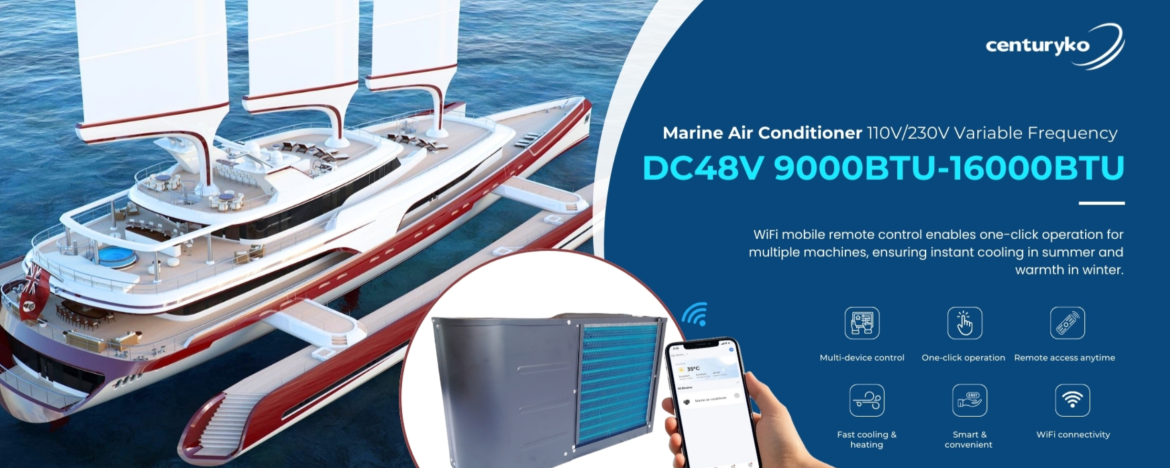
Comparative lead: why material science matters at sea
Choosing a heavy-duty unit for a vessel is more than picking cooling capacity; it’s about picking longevity and uptime under salt spray, sun and constant vibration. In a direct side-by-side, a well-engineered self contained marine air conditioner with corrosion-resistant internals will outlast a cheaper unit by years in the Mediterranean or North Sea—real-world routes where salinity and choppy conditions accelerate wear. During an operational production teardown of a self contained marine air conditioner, the inverter, compressor and heat exchanger layout made clear which components face the worst corrosion stress and why material choice is decisive.
Performance vs. durability: what you’re really comparing
Tank capacity and BTU numbers tell only part of the story. The condenser and evaporator coil material, protective coatings, and the sealed compressor design determine whether you’ll be doing annual dry-dock repairs or cruising season after season. In comparative terms:
– Copper-nickel alloys offer good heat transfer but need careful isolation to avoid galvanic corrosion when mated to other metals. – Titanium coils resist pitting in seawater and keep heat-exchanger performance stable. – Coated aluminum or stainless housings reduce surface corrosion but rely on proper sacrificial anode and grounding strategies.
These choices directly affect service intervals, spare-parts logistics and total cost of ownership.
Common failure modes and why they start at the surface
Salt-laden air and constant moisture lead to pitting, crevice corrosion and galvanic attack on connection points. That can cause refrigerant leaks, clogged seawater pumps and premature compressor wear. The inverter electronics are also vulnerable to corrosion-induced shorting unless sealed and conformally coated—so a marine ac inverter is less an optional feature and more a reliability anchor. Field inspections often show corrosion begins at joints and fasteners rather than the big cast parts—so attention to small details matters. —Maintenance crews learn this the hard way when a tiny leak turns into a system swap.
How top designs mitigate corrosion
Manufacturers take several parallel approaches. Robust units use titanium heat exchangers, hermetically sealed compressors, and stainless or powder-coated housings. Electricals get conformal coatings and sealed enclosures; wiring harnesses use marine-grade connectors. Cathodic protection via sacrificial anodes or impressed-current systems reduces galvanic currents between dissimilar metals. A smart layout also isolates the seawater circuit from the refrigerant loop, and places the inverter where it’s protected from spray and deck run-off.
When comparing models, look for documented materials (titanium coil, copper-nickel seawater tubing) and clear service access. The marine ac inverter link in spec sheets often reveals how manufacturers prioritize electronics sealing and thermal management—use that as a selection cue.
Installation and maintenance mistakes that shorten life
Even the best design fails under poor installation. Common errors: using mixed-metal fittings without dielectric breaks, incorrect grounding that creates stray currents, routing seawater hoses where chafe will occur, and applying inappropriate fasteners that corrode quickly. Routine flushing of seawater circuits and scheduled inspections of sacrificial anodes prevent accelerated wear. Avoid cheap aftermarket parts that compromise the original materials—replacement heat exchangers and pumps should match the corrosion-resistant specs of the original design.
Three golden rules for selecting heavy-duty marine AC
Rule 1 — Corrosion-resistance rating and materials. Verify explicit materials for heat exchangers, condenser tubing and housings; prefer titanium or properly isolated copper-nickel when operating in coastal/high-salinity zones.
Rule 2 — Expected service life and maintenance footprint. Choose units with accessible service points, documented maintenance intervals, and a clear plan for sacrificial anode replacement. Measure total cost over expected life rather than initial price.
Rule 3 — Warranty, parts support and electrical protection. Ensure the inverter electronics are sealed and supported regionally; warranty that covers corrosion-related failures signals manufacturer confidence.
These three metrics guide a pragmatic decision and naturally lead to solutions like the models offered by ZhuoliMarine, which pair titanium exchangers with sealed compressors and strong parts support — practical details that reduce downtime and long-term expense. —A final thought: get the material spec in writing.