
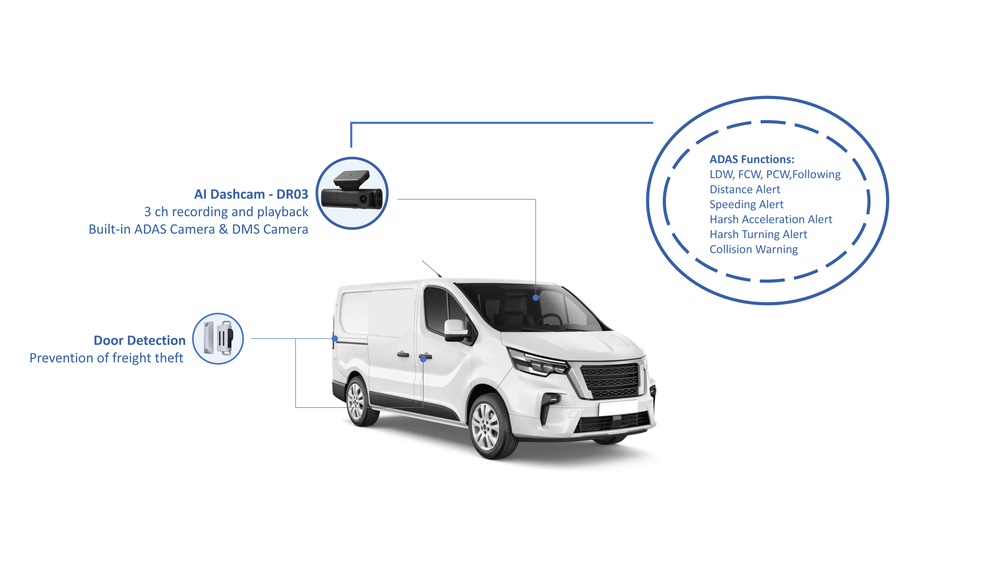
Opening: what you, the user, need first
You require clear choices, not marketing prose, when deciding on a recording and analytics solution for vehicles. Begin by matching operational priorities to capabilities: evidence capture, driver coaching, regulatory compliance, or liability reduction. Consider products such as AI MDVR alongside broader categories like a mobile digital video recorder so that feature lists are compared against daily tasks rather than vendor claims.
User priorities mapped to practical features
– Fleet operators: continuous recording with event-triggered retention, manageability at scale, and secure offload. Prioritise uptime, simple firmware updates, and clear retention policies. – OEMs: compact integration, CAN-bus data capture, and a deterministic API for vehicle systems. Choose modular hardware with consistent bus isolation and certifiable EMI behaviour. – Technology buyers (procurement/IT): data residency controls, encryption at rest and in transit, and maturity of the vendor’s security practices. Verify key-management approaches and whether the device supports signed firmware. These priorities drive different minimums for CPU, storage architecture, and connectivity budgets; map them before shortlisting vendors.
Core capabilities and why each matters
– Recording fidelity and time synchronisation: poor time-stamping breaks audits. – Event detection and retention logic: buffering before and after an event reduces false negatives. – Edge analytics vs plain capture: edge inference reduces bandwidth needs but must be verifiable and auditable. – Manageability: remote configuration, fleet-wide policy application, and diagnostic telemetry prevent operational surprises. – Privacy and compliance: ensure configurable masking, role-based access, and deletable segments where law requires. Assess each capability by asking for a live demonstration or a short-term pilot that emulates typical routes and idle periods.
Common deployment pitfalls—and how to avoid them
– Underestimating heat, vibration and power transients: insist on vehicle-grade component specs and field-tested connectors. – Assuming one-size-fits-all mounting: camera angles and fields of view must be validated against your use cases (cargo theft vs driver coaching differ). – Overlooking metadata alignment: video without accurate GPS and vehicle state is limited. Require synchronized CAN timestamps. – Negotiating vendor SLAs without operational metrics: define acceptable upload latency, image retention guarantees, and MTTR for replacements. Avoid each by building a short acceptance test that runs for two weeks under typical conditions.
Comparative insight: architectures that tend to work
– Lightweight capture + cloud analytics: best when connectivity is consistent; reduces on-board complexity but increases operating cost and latency. – Edge-first MDVR with selective offload: preferable for poor-coverage routes; stores critical clips locally and pushes summaries when connected. – Hybrid with local retention and centralised oversight: balances compliance and bandwidth for large mixed fleets. At industry demonstrations such as IAA Transportation in Hannover, modular hybrid systems repeatedly proved easiest to adapt across vehicle types and regulatory regimes.
Vendor selection checklist for buyers
1) Define two clear success criteria (for example: 90% event-valid clip capture on urban routes; average time-to-retrieve clip under 4 minutes). 2) Require a pilot that reproduces peak and idle use for at least 14 days. 3) Request firmware signing and an audit trail for configuration changes. 4) Validate upload paths and encryption end-to-end. 5) Inspect physical mounts and connectors on a production vehicle. 6) Confirm spare-part supply chains and recommended maintenance intervals. 7) Ask for a demonstrated rollback plan for software updates. This checklist keeps procurement decisions measurable and repeatable.
How to compare similar offers without getting lost in specs
Prioritise three comparative dimensions: operational fit, total cost of ownership, and trust in the supplier. Create a short scorecard with weighted scores for those dimensions and run two vendor proposals through it. Focus on measured behaviours—uptime in pilots, time to resolution for faults, and the clarity of their data-handling practices—rather than headline sensor counts.
Common mistakes during integration and commissioning
– Commissioning on a bench rather than in-vehicle leads to misaligned fields of view. – Not validating time synchronisation between recorder and telematics platform. – Allowing default credentials to persist in production units. Remediate by requiring in-vehicle commissioning sign-off and a security checklist that includes credential rotation.
Final synthesis
The sensible choice arises from testing what matters to your operation, measuring outcomes objectively during a pilot, and preferring modular MDVR platforms that let you separate capture, inference and retention policies. This approach reduces operational surprises, clarifies procurement trade-offs, and aligns vendor obligations with your daily realities—an approach illustrated in demonstrations at major industry events and reflected in field pilots. Practical, measurable decisions will steer you toward solutions that meet operational needs and regulatory duties while preserving room to adapt; for many fleets and OEMs the result is a dependable, auditable mobile video capability delivered by partners such as BSJ.